

Boost Sales: Ecommerce Website Design Dublin 2026
If you're looking at ecommerce website design in Dublin, you're probably in one of two positions. Either you're replacing a site that looks fine but doesn't generate enough orders, or you're building your first proper online store and trying to avoid an expensive mistake.
Most Dublin business owners don't struggle with the idea of selling online. They struggle with the decisions around it. Which platform fits. What the build should include. Why one quote is low, another is high, and neither clearly explains what happens after launch. That's where ecommerce projects often go wrong. The build gets priced. The lifetime cost doesn't.
A good ecommerce site isn't just a homepage, a few product pages, and a checkout. It's a trading system. It needs to be usable, secure, manageable by your team, and designed around how Irish customers buy. It also needs ongoing care. Security updates, backups, GDPR checks, speed work, and support don't stop once the site goes live.
Table of Contents
- Your Dublin Ecommerce Blueprint Process and Timeline
- Choosing Your Engine WordPress vs Shopify for Irish Businesses
- Decoding the Cost of Ecommerce Website Design in Dublin
- Hosting Security and GDPR Your Digital Foundations
- Designing for Sales SEO and Conversion in the Irish Market
- Beyond Launch Maintenance Support and Continuous Growth
- Finding Your Partner Key Questions to Ask Any Dublin Agency
Your Dublin Ecommerce Blueprint Process and Timeline
Most ecommerce builds fail at the beginning, not the end. The problem usually isn't coding. It's poor scoping, rushed decisions, and a vague brief that leaves too much open to interpretation.
A solid project has a sequence. If you skip the sequence, you pay for it later in change requests, delays, and awkward workarounds.
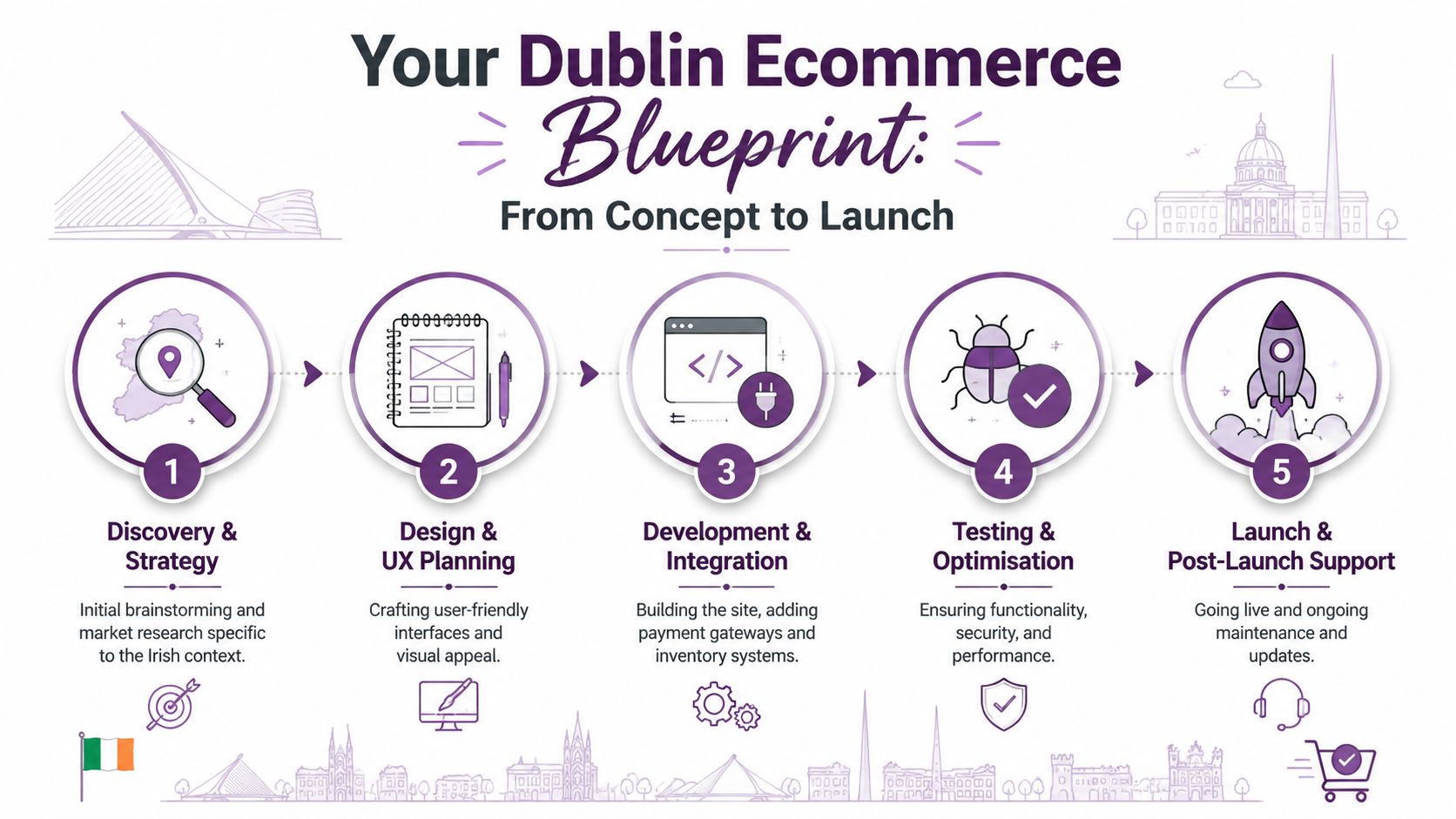
What happens before anything is designed
The first phase is discovery and strategy. In this phase, the agency should pin down what you're selling, who you're selling to, how orders will be fulfilled, what systems must connect, and what your team needs to manage internally. If you're selling a handful of products with simple shipping, that setup is very different from a store with product variants, stock rules, trade pricing, or multiple delivery options.
Then comes UX planning and design. This isn't about colours first. It's about structure. Your category layout, product filtering, product page hierarchy, cart behaviour, and checkout path all need to make sense before anyone polishes the visuals.
Practical rule: if an agency wants to jump straight into homepage mock-ups without discussing products, shipping, fulfilment, and customer journeys, they're designing the shopfront before they've understood the business.
The build phase that decides whether launch is smooth
After design approval, the work moves into development and integration. During this phase, the site is built, payment gateways are connected, shipping settings are configured, tax rules are checked, and any third-party tools are wired in. For many Dublin SMEs, content population also becomes a hidden bottleneck during this stage. Product images, descriptions, size charts, policies, and category copy all take longer than expected.
Testing comes next. Good agencies don't treat testing as a final click-through. They test checkout flow, form behaviour, mobile rendering, speed, admin usability, broken links, and order notifications. They also check what happens when real users do slightly messy things, such as applying a code incorrectly, abandoning cart, or changing quantities mid-checkout.
A realistic custom ecommerce website design Dublin project usually runs on a timeline measured in weeks, not days. In practice, many builds land in the 8 to 16 week range, depending on complexity, content readiness, and approvals. That range is part of the project brief you provided, and it's the right mindset to keep. A serious online store isn't an overnight build.
A simple way to think about the journey is this:
- Strategy first so the build matches your business model.
- UX second so shoppers can buy without friction.
- Development third so systems work together cleanly.
- Testing before launch so problems are fixed before customers find them.
- Training at the end so your team isn't dependent on the agency for every product edit.
The final handover matters more than many owners realise. Your team should know how to process orders, edit products, update content, and spot issues early. If they can't, the site may be live, but the business still isn't ready.
Choosing Your Engine WordPress vs Shopify for Irish Businesses
The platform question is frequently oversimplified. People ask which one is better. The better question is which one fits your operating model.
For most Dublin SMEs, the comparison is WordPress with WooCommerce versus Shopify. Both can run a professional online shop. The difference is how much control you want, how much flexibility you'll need later, and how comfortable you are with ongoing ownership responsibilities.
Where WordPress and WooCommerce fit best
WordPress with WooCommerce suits businesses that want deeper control over content, SEO structure, design flexibility, and integrations. It's especially useful when ecommerce is only one part of the website. If you also need service pages, booking logic, location content, custom landing pages, or customized content workflows, WordPress usually gives you more room to build around the business rather than forcing the business into the platform.
It also suits owners who want site ownership. You control hosting, plugins, theme structure, and the wider technical stack. That freedom is valuable, but it also means someone has to maintain it properly. Updates, compatibility checks, backups, and security monitoring don't happen by magic.
A Dublin agency such as Web House Team works in this model, building WordPress-powered ecommerce sites alongside hosting and maintenance, which can suit companies that want one supplier handling both the build and the ongoing technical side.
Where Shopify makes more sense
Shopify is often the cleaner choice if speed to market matters most and your store requirements are relatively standard. It reduces technical overhead. The admin is straightforward. Many owners find product management easier on day one. If you're focused on getting a store live with fewer moving parts, Shopify can be the sensible option.
The trade-off is flexibility. Shopify works best when you stay close to the way Shopify wants stores to operate. Once a business needs unusual product logic, advanced content structures, or bespoke integrations, costs and constraints can show up in other places.
A practical side-by-side view helps:
| Decision area | WordPress and WooCommerce | Shopify |
|---|---|---|
| Ownership | Greater control over hosting and site stack | Platform-managed environment |
| Customisation | Strong for bespoke layouts and workflows | Strong within platform boundaries |
| Content depth | Excellent for SEO-heavy and content-led stores | Good, but less flexible for complex content structures |
| Maintenance | Requires active technical management | Lower direct maintenance burden for owners |
| Ease of use | Depends on build quality and training | Generally simpler out of the box |
If you're stuck between the two, this comparison of platform decision by Ecommerce Boost is useful because it frames the choice around business fit rather than hype.
Shopify is easier to start with. WooCommerce is often easier to grow with when the business stops being standard.
The wrong choice isn't choosing one over the other. It's choosing without thinking about year two. That's when catalogues expand, marketing gets more ambitious, and operational edge cases start appearing.
Decoding the Cost of Ecommerce Website Design in Dublin
The first quote rarely tells the full story. It usually tells you the cost of getting a site built. It doesn't always tell you the cost of operating it properly.
That matters because ecommerce website design in Dublin isn't a single product. A template-based starter shop, a customized WooCommerce build, and a custom ecommerce platform are different jobs with different risks, workloads, and support requirements.
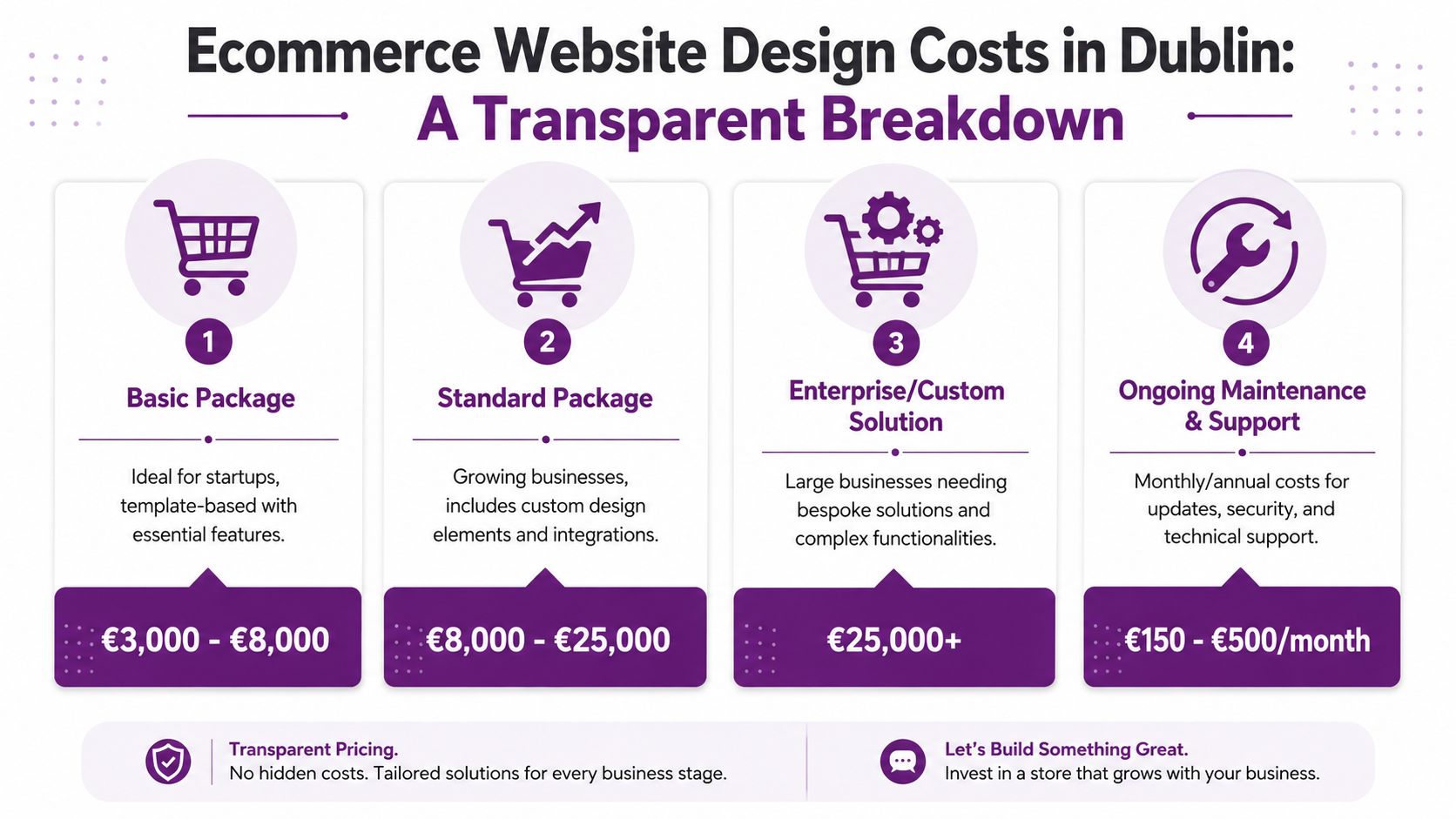
What actually drives the quote
The biggest cost drivers are usually scope, not appearance. A clean design can be relatively simple. Complex operations are what make projects expensive.
Typical pricing pressure comes from factors like these:
- Catalogue complexity. A store with simple products is easier to build than one with variants, bundles, custom options, or layered categories.
- Integration work. Payment gateways, shipping rules, ERP connections, stock systems, CRM syncs, and marketing tools all add build time.
- Content preparation. Agencies can only move as fast as the material they receive. Product data, imagery, legal pages, and category copy often take more effort than owners expect.
- Custom admin needs. If your staff need unusual workflows inside the back end, that usually requires extra development.
- Design depth. Custom templates are one thing. Fully custom interface work across homepage, category pages, product pages, account areas, and checkout is another.
There's also the value side. In Ireland, 60% of consumers rate usability as an essential web design characteristic for online shops, according to Cliqued Media's ecommerce web design statistics for Ireland. That's a useful benchmark because it ties design quality to customer expectation, not aesthetics. If the site feels awkward, people leave. If navigation is clear and checkout feels dependable, trust rises.
What a lower quote usually excludes
A cheap quote isn't always bad. But it usually involves a boundary somewhere. The danger is when that boundary isn't obvious until the project is underway.
Look closely at what's included in writing:
- Product upload responsibility. Are they adding products, or are you?
- Revision rounds. How many design and development revisions are covered?
- Training. Will your team get a handover session, recorded walkthroughs, or written guidance?
- Technical setup. Does the price include analytics, redirects, transactional email setup, and on-site forms?
- Post-launch support. Is there a support window after launch, or does billing restart immediately?
A quote becomes expensive when every necessary item appears later as a separate line item.
The useful way to budget is to split the investment into two categories. First, the build cost for strategy, design, development, testing, and launch. Second, the operating cost for hosting, maintenance, support, security, and compliance. Owners who plan for both make calmer decisions and usually avoid the stop-start rebuild cycle that traps a lot of small retailers.
Hosting Security and GDPR Your Digital Foundations
If your ecommerce site is the shop, hosting and security are the premises, locks, alarms, and insurance. They aren't glamorous, but weak foundations create expensive problems.
Most store owners only notice hosting when something goes wrong. The site slows down, checkout behaves oddly, emails stop landing, or a plugin update breaks part of the shop. By then, the hosting decision has already shaped the outcome.

What secure hosting should include
For an ecommerce site, good hosting should include more than server space. At minimum, you want SSL, backups, malware scanning, a firewall, update management, and someone responsible for monitoring issues before they become customer-facing.
Managed hosting is often worth it for SMEs because it removes fragile DIY setups. That doesn't mean premium for the sake of it. It means clear responsibility. When orders are involved, there should be no ambiguity about who handles downtime, restores, or security incidents.
A sensible hosting checklist looks like this:
| Foundation | Why it matters |
|---|---|
| SSL and HTTPS | Protects data in transit and builds trust at checkout |
| Backups | Gives you a recovery path if updates or attacks cause damage |
| Firewall and malware monitoring | Reduces exposure to common attacks |
| Update management | Keeps themes, plugins, and core software current |
| Support access | Lets your team get help quickly when trading is affected |
What GDPR means in practical site terms
For Irish ecommerce, GDPR isn't a badge in the footer. It's a technical and operational requirement. The verified data states that GDPR compliance requires measures like TLS 1.3+ encryption and EU-hosted databases, and that 82% of Dublin web agencies now embed these GDPR-by-design features into builds, with fines that can reach €20M according to Clutch's Dublin ecommerce agency listing data.
In practical terms, that affects how consent is collected, where customer data is stored, how forms and checkout data are protected, and how third-party tools are selected. Cookie consent must be granular and opt-in. Customer data needs secure handling. If agencies talk about GDPR only as a line in a proposal, that's not enough.
Security and compliance should be specified in the build and maintained after launch. If they're treated as optional extras, the site isn't properly production-ready.
Many business owners require plain speaking on this matter. A site can look polished and still be exposed. Hosting, updates, data handling, and access control decide whether the store is professionally run or just professionally designed.
Designing for Sales SEO and Conversion in the Irish Market
Design should make buying easier. That's the test. Not whether the homepage looks modern, but whether the right customer can find the product, trust the store, and complete the order without friction.
In the Irish market, mobile behaviour changes the design brief from the start. Verified data shows that 68% of online purchases in Ireland happen on mobile devices, and that a 1-second load delay can reduce average order value by 7%, based on the cited Irish ecommerce mobile performance reference. That's why mobile-first design isn't a style preference. It's an operating requirement.
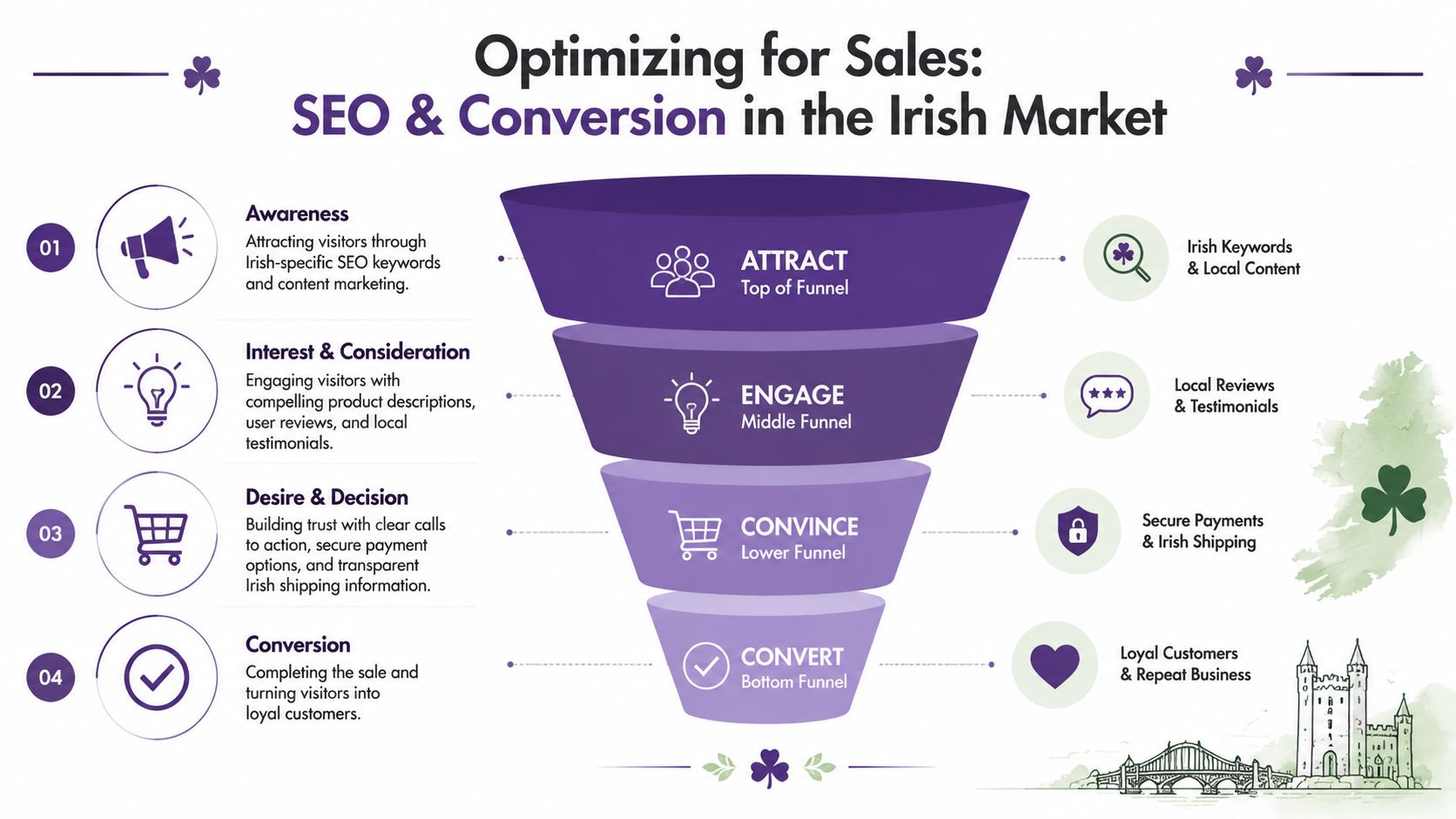
Mobile speed is a sales issue
A lot of weak stores make the same mistake. They design on a desktop screen, shrink it later, and call it responsive. The result is usually cramped menus, hard-to-use filters, oversized banners, and checkout forms that feel like work.
A store designed for mobile-first trading handles the basics properly:
- Navigation stays simple. Category access should be obvious, not buried behind clever labels.
- Product pages load cleanly. Images, price, delivery information, and add-to-cart controls need to appear quickly and in the right order.
- Forms ask for only what's needed. Every unnecessary field adds friction.
- Buttons are easy to tap. Small tap targets still break a surprising number of mobile checkouts.
SEO and checkout shape the same outcome
SEO and conversion are often treated as separate jobs. They aren't. Search brings the visitor in. UX decides whether they stay. For ecommerce website design Dublin projects, that means category structures, page titles, internal linking, product copy, image handling, and schema-ready product data all need to be thought through early rather than patched on later.
Conversion matters just as much. Across the global ecommerce market, sites average conversion rates between 2.5% and 3%, according to Hostinger's web design statistics roundup. That's a useful baseline, not a promise. If your store is below that range, the answer usually isn't one dramatic redesign. It's a sequence of smaller fixes across navigation, product pages, trust signals, delivery communication, and checkout flow.
For checkout specifically, this guide to best practices for checkout design is a worthwhile reference because it focuses on reducing friction where many stores unknowingly lose sales.
A few design choices repeatedly outperform the flashy ones:
- Clear product information beats sparse minimalist layouts.
- Visible delivery and returns details beat hidden policy links.
- Strong category logic beats clever branding language.
- Shorter checkout paths beat decorative multi-step friction.
If a shopper has to stop and think about where to click, the design is already working against the sale.
The strongest stores in Dublin usually don't feel complicated. They feel organised. That's what converts.
Beyond Launch Maintenance Support and Continuous Growth
Launch day is a milestone. It isn't the finish line.
A lot of agencies still sell ecommerce as a project with an endpoint. Build, approve, go live, done. In practice, that's when the site starts facing real conditions. Customers behave unpredictably. Plugins update. Security issues appear. Product ranges change. Marketing campaigns expose weak pages. The live environment tells you what the build missed.
What ongoing support should cover
A proper support arrangement should cover the routine work that keeps an online store stable and compliant. That includes software updates, backups, uptime monitoring, malware checks, performance review, broken checkout issue handling, and practical help when your staff need something changed quickly.
Good maintenance also includes process, not just tools. Someone should know when updates are applied, how the site is tested after changes, and what happens if an update causes a conflict. That level of discipline is what separates a maintained site from a site that hasn't failed yet.
A useful maintenance scope often includes:
- Core and plugin updates carried out on a schedule with checks afterwards.
- Security monitoring so suspicious activity is caught early.
- Backups and recovery planning in case the site needs to be rolled back.
- Content and product support for routine trading changes.
- Compliance upkeep so privacy-related settings don't drift out of date.
Why maintenance is cheaper than recovery
One of the most overlooked costs in Dublin ecommerce is post-launch GDPR maintenance. Verified data states that 42% of Irish SMEs face penalties due to post-launch compliance lapses, which is drawn from Meath Web Design's discussion of ongoing GDPR maintenance costs. The key point isn't just the percentage. It's the reason. The issue isn't only bad initial builds. It's that compliance needs ongoing attention.
That changes how you should view monthly support. It's not dead money. It's operational protection. Cookie tools need checking. Plugins need updating. Data handling needs review when forms, apps, or marketing tools change. Even simple site edits can create compliance knock-on effects if no one is watching the whole setup.
A site without maintenance usually drifts in three ways:
| Drift area | What happens |
|---|---|
| Technical | Updates pile up and compatibility risk grows |
| Security | Vulnerabilities stay open longer than they should |
| Compliance | Live site behaviour stops matching the original setup |
Owners often ask whether they can manage this internally. Sometimes they can. If someone in the business has the time, the technical judgement, and the discipline to keep records and test changes, internal ownership can work. If not, a maintenance partner is usually cheaper than dealing with downtime, broken checkout flow, or a privacy problem after the fact.
Finding Your Partner Key Questions to Ask Any Dublin Agency
Choosing an agency gets easier when you stop asking only about design and start asking about operations. Portfolios matter, but ecommerce success usually depends on what happens behind the portfolio.
Questions that reveal how an agency really works
Ask direct questions and listen for direct answers:
- Who handles hosting and technical support after launch? You want one clear owner, not finger-pointing between developer, host, and freelancer.
- How do you manage updates and test the site afterwards? If the answer is vague, expect avoidable breakages later.
- What does post-launch GDPR support include? This should cover more than a statement that the site is compliant at handover.
- Will you train our team to manage products, content, and orders? Dependence on the agency for every small task gets expensive fast.
- How do you scope revisions and change requests? This tells you how likely the project is to stay under control.
- What happens if checkout breaks on a Friday afternoon? Support quality shows up most clearly in edge cases.
You should also ask to see work that resembles your business model, not just attractive websites. A fashion shop, a B2B catalogue, a food retailer, and a service-led store with ecommerce attached all have different requirements.
A good agency won't dodge difficult questions. They'll answer them in plain terms, explain the trade-offs, and tell you where your internal team will need to play a role.
If you're planning an online store and want a grounded conversation about build scope, hosting, and long-term support, Web House Team is a Dublin-based option that handles website design, WordPress ecommerce development, managed hosting, and ongoing maintenance under one workflow. That setup can be useful if you want one provider responsible for both the launch and the day-to-day running of the site.
Refined using the Outrank app